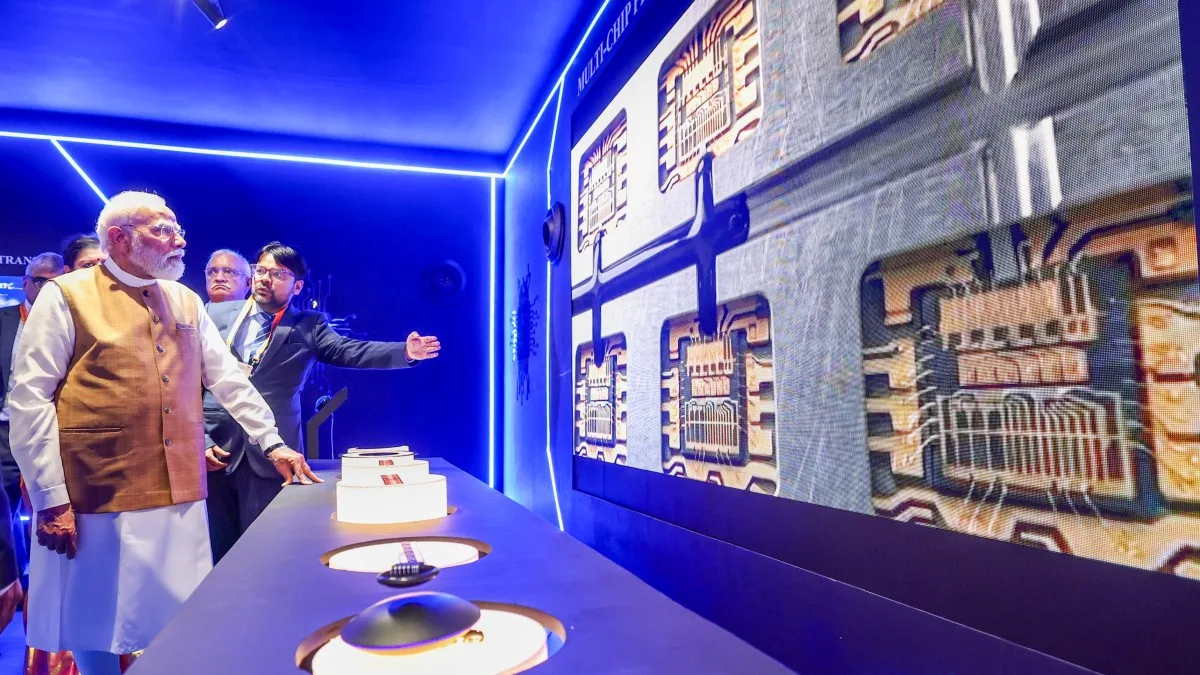
Prime Minister Narendra Modi on Tuesday inaugurated a Rs. 3,300 crore semiconductor facility by Kaynes Semicon at Sanand GIDC in Ahmedabad, Gujarat, marking another step in India’s push to become a global electronics manufacturing hub.
The Prime Minister said India’s semiconductor market is on track to exceed $100 billion by the end of the decade, underlining the rapid expansion of the country’s electronics and chip ecosystem.
Advertisement
The government aims to position India among the top six semiconductor nations by 2032 and enter the top three globally by 2047.
With multiple projects underway, rising global partnerships, and a growing talent base, India is positioning itself as a reliable player in the global semiconductor supply chain while targeting a $100 billion domestic market.
Rapid expansion in SEMICON sector
The Sanand facility is the second semiconductor plant in India, following the inauguration of Micron Technology’s unit in February. A third facility is expected to be operational by July.
The Kaynes plant, an OSAT (Outsourced Semiconductor Assembly and Test) facility, will manufacture advanced components, including intelligent power modules, many of which are already seeing strong export demand.
Addressing the gathering, Modi referred to the development as a symbolic bridge between India and Silicon Valley. He said the current period represents a “decade of India,” driven by strong policy support and industrial growth.
Union Electronics and Information Technology Minister Ashwini Vaishnaw said India is accelerating its semiconductor roadmap, with four plants expected to be ready by 2026 and two more by 2027. He added that the country’s first semiconductor fabrication unit is likely to be operational in Dholera by 2028.
India’s Semiconductor Mission
The Prime Minister pointed to the India Semiconductor Mission as a key pillar of this transformation, aimed at building domestic capabilities across the semiconductor value chain.
PM Modi highlighted the next phase of the programme, India Semiconductor Mission 2.0, announced in the Union Budget. The new phase will focus on domestic manufacturing of semiconductor materials and equipment, to create a complete, self-reliant ecosystem.
He also noted India’s participation in global supply chain initiatives such as Pax Silica and ongoing collaboration with international partners.
Currently, 10 semiconductor projects are worth Rs. 1.6 lakh crore are under implementation across six states.
85,000 professionals to be trained
To support industry growth, the government plans to train over 85,000 semiconductor design professionals. Around 400 universities and startups have already been given access to advanced chip design tools, resulting in the development of more than 55 semiconductor designs.
Nearly 60,000 engineers have already been trained in advanced chip design tools, such as Synopsys and Cadence, while global firms such as Nvidia, AMD and Intel are expanding design operations in India, including work on cutting-edge 2-nanometre chips.
The Prime Minister said the aim is to scale up domestic chip production in line with national demand and export opportunities.
Mnatra: ‘Make in India, Make for the World’
Modi said products manufactured at the Sanand facility are already booked for export, including supplies to companies in California. He emphasised that India’s semiconductor ambitions extend beyond domestic consumption, aligning with the broader “Make in India, Make for the World” vision.
He hailed it as a moment of pride that characterises the mantra of “Make in India, Make for the world.”
He added that “Atmanirbhar in the semiconductor sector is not limited to a single chip,” but it will have a multiplier effect across sectors such as artificial intelligence, electric vehicles, clean energy and defence.
He expressed confidence that the products originating from the Sanand plant will eventually reinforce India’s identity as a “factory of the world.”